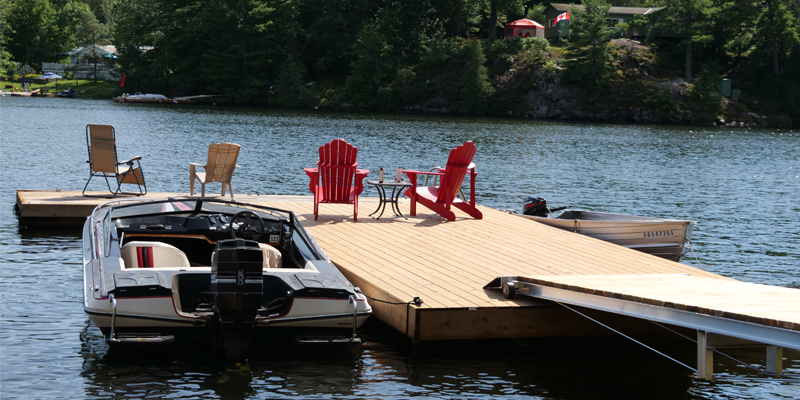
complete systems
Whether it's for a small camp or a marina,
we've got you covered from beach to boat.
Morgan Williams Enterprises (M.W.Ent.) was founded in 2008 to fill a need for locally manufactured and supported, high quality floating docks. There are several important details that elevate the Envirodock system above the competition. The best customer is an informed customer. If you want the highest quality, longest trouble free lifespan, and most secure dock investment your money can buy, read on!
There are three main design points you should be aware of:1. The lifespan of foam floats and plastic "cube" flotation systems is relatively short, making the investment in those systems economically and ecologically unsound. Our research and design experience has led us to the use and manufacturing of HDPE (plastic) pipe floats. This strong and very durable material is leak proof, corrosion resistant, flexible, fatigue Resistant, lightweight, and cost effective. This environmentally friendly plastic is approved for use with potable (drinking) water and will not leak dangerous chemicals into the water like many other plastics. The plastic in these floats is over 1/2" thick. In comparison, the flat sided cube floats are significantly weaker and less resiliant. Most have a much thinner wall at roughly 1/8", making them more prone to damage from ice, boats, or other objects bumping into them. This increased wall thickness (over 4 times!) exponentially increases the durability of the floats, the most crucial component of any floating dock. Most manufacturers of plastic cube floats fill their cubes with foam, because THEY KNOW, their floats will be punctured and/or begin to leak. If you have spent much time around boats and/or floating docks, you know that even closed cell foam will eventually become waterlogged and sink as a result. Foam is simply a temporary fix to a well known issue. There are many foam filled cubes in landfills...
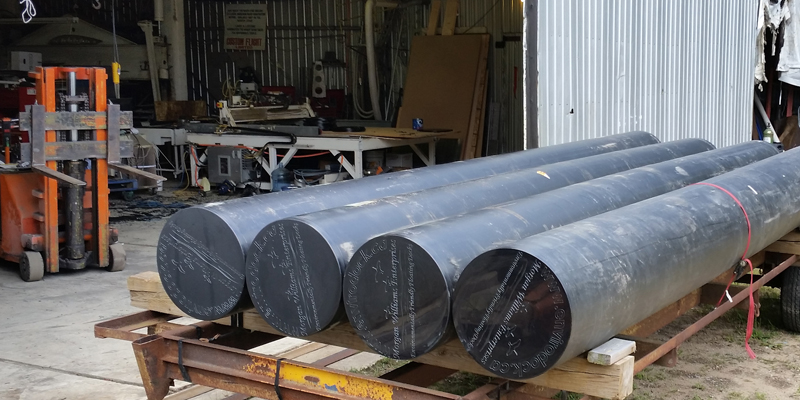
The manufacturing process of our floats begins with HDPE (High Density Poly Ethylene) pipe 18 inches in diameter with a wall thickness slightly greater than 1/2", and end plates CNC cut from 3/4” thick HDPE sheet. This same pipe is widely used in municipal water systems and pipelines. The majority of plastic pipe dock manufacturers use handheld extrusion welders to weld end plates into the floats. We also used this process for 5 years. This method is labour intensive, but more importantly, the quality and longevity of the weld depends completely on the welder’s skill, attention to detail, AND LUCK.
The method most widely used in industry and pipeline construction, utilizes a "Hot Plate Welder". These machines are very precise, with computer controlled heaters and regulated hydraulic systems to apply the optimum temperature and pressure. The machines locate and weld all components with consistent repeatable precision. They produce the most uniform, and strongest welds available. VERY FEW Dock manufacturers use this process, because the purchase price of a plate welder is $30,000.00 or more. At M.W.Ent., we only want to produce the highest quality, and for this reason we invested in, and have our own Hot Plate Welder. This allows us to do all manufacturing in house, and to the highest standards.
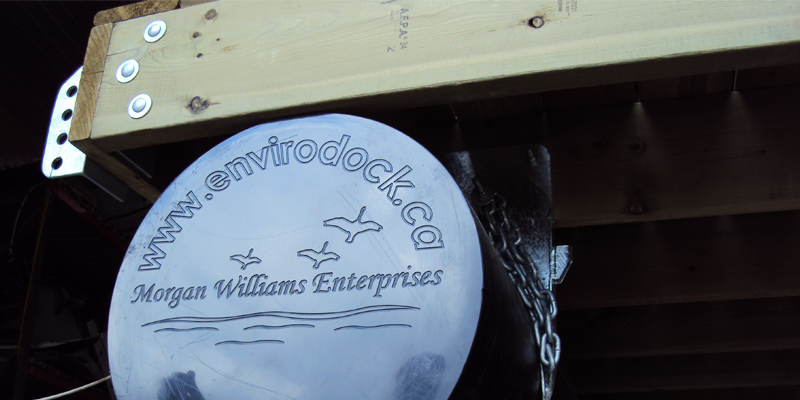
If the end plate of a plastic dock float is set into the pipe a few inches, it was not welded with a plate welder.
We have learned a lot in the 12+ years we have been designing and building floating docks.
2. Things expand and shrink as the temperature changes. This is a fact of nature and a headache for engineers. A 24 foot plastic pipe, for example, will shrink or expand as much as 2.5 inches due to common annual temperature changes (from +300C in summer months, down to -300C during the winter). This creates a problem, since the wooden deck has a coefficient of expansion much lower than that of the plastic supporting it. A 24 foot wooden joist (pine) will increase or decrease in length less than 1/8” over the same temperature range! If the deck is competely fixed to the pipe along its entire length, and the pipe decreases in length by 2.5", something is going to break. To get around this, many builders attach the deck in a "loose" fashion, often using 4x4's piled "crisscross", and held together with long bolts in oversized holes. When the pipe length changes repeatedly each season, over the years the wood bends, bolts twist, holes wear, and plastic brackets crack...
Accepting that we can’t control Mother Nature and thermal expansion, we have designed our docks in such a way that allows this movement, in order to avoid unnecessary stress and damage. We developed and manufacture the Envirodock Saddle Bracket System (S.B.S.), which allows the natural expansion and contraction of the pipe along its length, while still securely mounting the decking and preventing any lateral movement of the floats, and eliminating any harmful stress concentrations. This system is unique to Envirodock floating docks, and is just one more reason we continue to float above the competition.
3. Attaching brackets. Now you have a high quality dock, but you need to attach it to the shore or another dock section. When engineering a structure, failure modes must be investigated. That is how the structure will fail or break under extreme load. If the thin, small, steel brackets sold in lumber stores, or by many dock builders, are bolted onto the end face board of the dock, a storm or winter ice movement will probably rip them off. They often come off with the splintered end board, or cause other avoidable damage to your valuable docks. We learned this, building floating docks for our own use. Just making them "heavy" is not the solution, they must withstand, and transfer, the applied load into the wooden deck in a way that the wood can accept the load without failing. To do this, our brackets extend roughly 3 feet up the side of the dock and roughly 1 foot across the end, with numerous bolts. This spreads out the load, decreasing the force on each bolt, and the force exerted on the wood at each hole, so we don't exceed the local load bearing strength of the wood. The corner brackets are made from heavy-duty 3/8” thick x 3” wide steel bar, and interlock using strong, 1” diameter steel pins. These brackets will last, but more importantly, they will allow the wood deck to last as well.
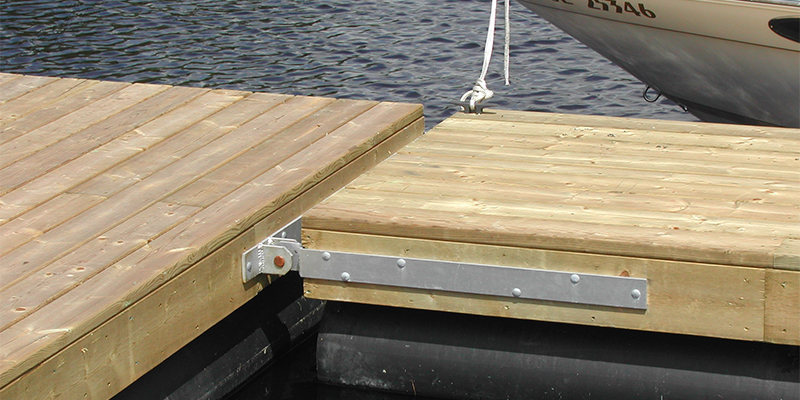
As you can see, producing the highest quality docks requires a lot of engineering and attention to detail.
We will not settle for anything but THE BEST. WILL YOU?
Our floats are also available separately, for those who wish to install their own joists and decking. This gives you the convenience of building the dock right at your home or cottage to your desired width. All float kits come with our Envirodock S.B.S., ready for you to bolt on the joists and decking.
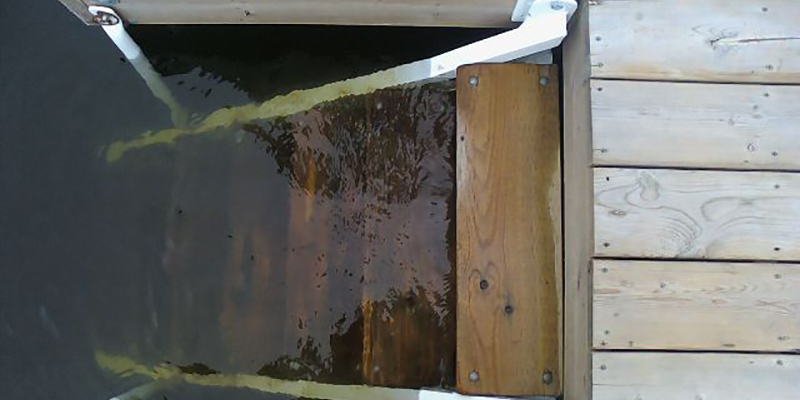
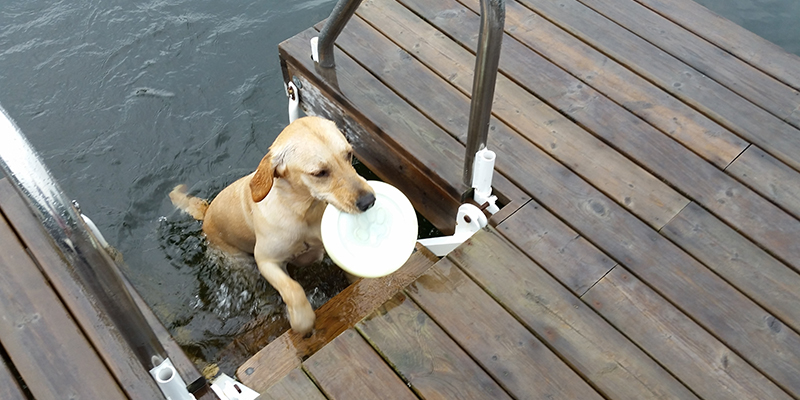
If you wish to further customize your new dock, add a built in staircase. Envirodock built in stair cases are set in to the end of the dock instead of a normal ladder which hangs off the end and can get in the way. They make getting in and out of the water very safe and easy. There is nothing protruding off the end of the dock, so boats can easily pull up along the end if extra docking space is desired. The stairs also hinge and can be pulled up out of the water when not in use.
Dogs love them too!
Envirodock - From beach to boat, we've got you covered!
Whether it's for a small camp or a marina,
we've got you covered from beach to boat.
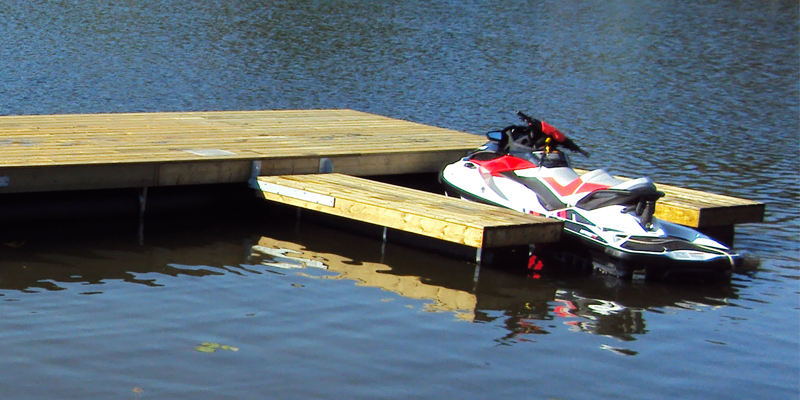
We understand that every customer is unique.
That's why every Envirodock system is custom built
to fit your specification.
Build your own Envirodock!
Custom float lengths available.
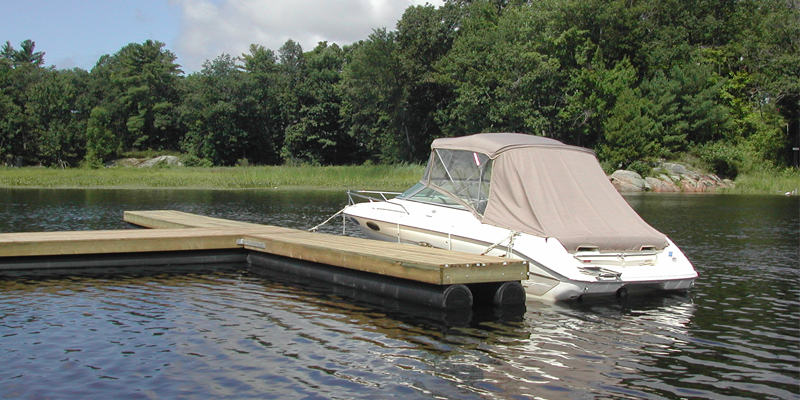
Completed Projects
Contact us today to find out how WE can HELP YOU!
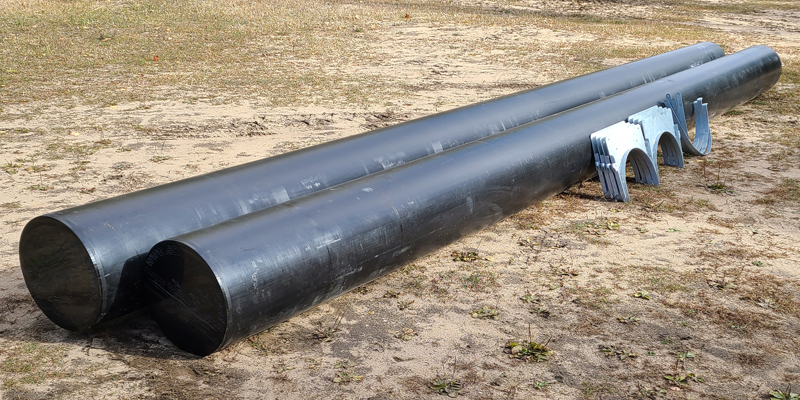
Available for immediate pickup/delivery
Morgan Williams Enterprises (M.W.Ent.) was founded in 2008 to fill a need for locally manufactured and supported, high quality floating dock systems.
Contact us TODAY to find out how we can HELP YOU!
Delivery Available!